
Ask any D2C founder in India how much they spent on creators last month. They'll answer in two seconds.
Now ask them which creators drove their last 100 orders.
That pause you just imagined? That's a ten-thousand-crore problem.
I haven't burned my own money on this. I've watched other people burn theirs. Over the last year of building Kosmc AI, I've spoken with founders and growth leads across 300+ D2C brands including Libas, Neemans, Conscious Chemist, Bacca Bucci, Lakshita, Tira, R for Rabbit, Famyo, and Little Box and the same conversation keeps repeating itself:
"How much are you spending on creators every month?" "Eight to twelve lakhs." "Which creators drove your last 100 orders?" "..."
That silence is what CollabX is built to kill. This post is why it exists.
The thing everyone gets wrong about Instagram
Marketers keep treating Instagram like Facebook Ads. It isn't.
Facebook Ads is a traffic channel. Someone sees an ad, clicks, lands on your site, buys. Linear. Trackable. Boring.
Instagram is a conversation channel. The real customer journey looks like this:
- Customer sees a creator post
- Screenshots it
- Watches two more posts from the same creator that week
- DMs the brand: "price?"
- Waits four hours for a reply
- Loses interest, or gets a generic copy-paste
- Maybe googles the brand
- Maybe buys
- Shows up in your analytics as "direct traffic"
At every step, two things are dying: the customer's intent, and your ability to know who sent them.
This is why discount codes barely move the needle - most customers screenshot the post and search the brand on Google instead of ever typing a code. It's why "website link in bio" UTMs quietly fail - customers don't click, they DM. It's why Google Analytics shows you "instagram.com" in your traffic report instead of "Creator A who posted on Tuesday."
Your attribution isn't slightly off. It's structurally broken because you're using web analytics to measure a conversation.
What we've actually seen inside brands
I'm going to share patterns, not names against numbers, because these brands trust us with their data.
A fashion brand running 1,000+ creators a month. Knew creator marketing was their #1 growth channel. Couldn't tell which 100 creators drove 80% of the revenue. They were scaling everyone equally which means they were overpaying the bottom 900 and underpaying the top 100.
A beauty brand spending ₹1.8L/month on creators. Beautiful engagement reports. Reach up, saves up, comments up. Revenue from creators? Best guess was "somewhere between ₹3L and ₹9L." That's not data. That's astrology.
An accessories brand getting 100+ product DMs a day. Response rate: 38%. Average reply time: over four hours. By the time they replied, more than half the customers had already moved on. They were losing customers their creators had already paid to acquire.
This is the part nobody writes Medium posts about. The leak isn't at the top of the funnel. It's in the DMs.
So why hasn't anyone fixed this?
I should be upfront: Kosmc AI already builds in the space next door. Link-in-bio, SmartLinks, chat automation - thousands of creators and brands use them every day. None of that goes away. CollabX sits on top.
But even with all of those working, a gap stayed open. And it's the same gap every other tool in this category leaves open too.
Every tool a D2C brand currently uses for creator marketing solves one slice of the journey. Storefronts solve where to send people. Short-link and UTM tools solve tracking a single creator's clicks. Chat automation solves replying to DMs before the customer loses interest. Creator management platforms solve briefs, contracts, and payouts.
Four useful things. Four different dashboards. Zero of them answer the only question a CFO actually asks:
Creator content → DM → conversation → click → cart → sale. Which creator drove which rupee?
That loop has never been closed in a single view. Not because the tools are bad - they're good at what they do but because nobody built the layer that sits on top of all of them and ties a sale back to the specific creator who started the conversation.
That's the layer CollabX is.
What CollabX actually is
The simplest way to describe it:
CollabX lets brands and agencies deploy chat automation across their entire creator roster and track every sale every creator drives, in one dashboard.
Read that again. The wedge is in there.
It's not "give a brand a dashboard." It's: deploy chat automation across 50, 500, or 5,000 creators at once, and see all of them in one place.
Concretely:
- Every creator gets a unique attributed link or smart destination, generated in bulk. No manual setup per creator.
- When a customer DMs after seeing a creator's post, automated replies fire instantly and the conversation is tagged to that creator from message one.
- Every click, cart, and purchase that flows through that creator's surface gets attributed back to them.
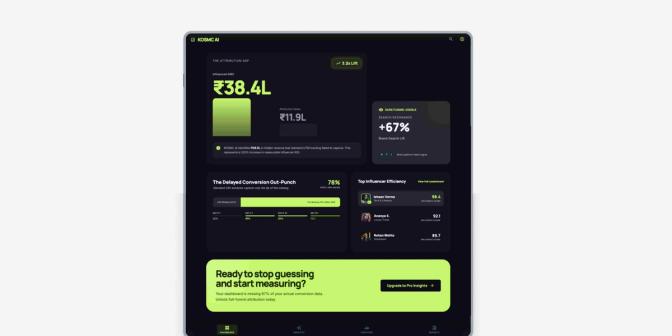
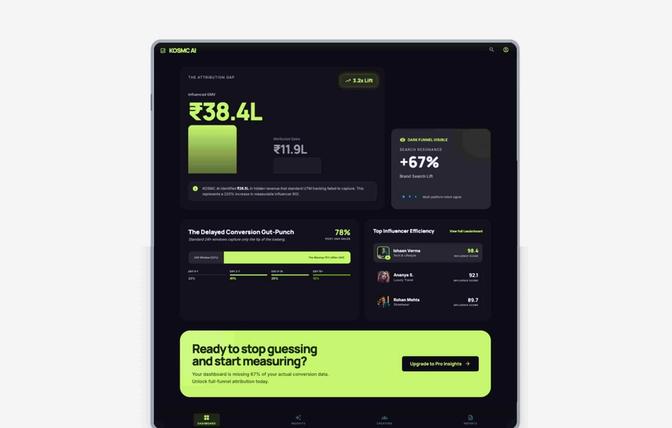
- The brand sees the whole roster in one view: Influence Score per creator, assisted conversions, cost per influenced sale, and the revenue that came in across the full 30-day window not just the 24 hours your last-click model is willing to count. Including Influenced GMV: the sales where a creator touched the journey even when the buyer never clicked a link, came back three days later, and converted through a Google search your brand didn't know it had earned. These are the numbers CFOs actually want on the slide. Not reach. Not saves. Not vanity.
- Creator payouts can be tied to actual sales, not posting. Performance, not promises.
For agencies running creator partnerships across multiple brands, this is the part that didn't exist before, managing chat automation and attribution across an entire roster, on behalf of clients, at scale.
The 5 questions every D2C founder should be able to answer
If you're spending money on creators, you should know:
- Which creator has the lowest CAC? If you don't know, you're overpaying the wrong people.
- What's your DM-to-purchase conversion rate? If you don't know, you're losing the customers your creators already warmed up.
- Which content type drives revenue — Reels, posts, or stories? If you don't know, you're briefing on instinct.
- Creator ROAS vs paid ads ROAS? If you don't know, you might be defending the wrong budget line in your next board meeting.
- How many of your "direct" traffic customers actually came from a creator? If you don't know, your analytics are quietly lying to you.
Most brands can't answer a single one. The ones that can are the ones winning.
Why I'm publishing this before the case studies
The standard founder playbook is: build quietly, get 100 paying customers, write the retrospective. I'm doing the opposite, on purpose.
CollabX is live. The brands I named at the top of this post are part of the Kosmc AI ecosystem, and we're learning what real creator attribution looks like at scale because of them.
I'm publishing now because the pattern is too obvious to sit on. Brands are losing crores every year on creator marketing they can't measure, and the people selling them "engagement reports" have no incentive to fix it.
If you're a D2C brand or an agency running creator partnerships and any of this sounds painfully familiar — talk to us. Not because I want to sell you something this week. Because the more brands we build this with, the better the loop gets for everyone.
What I'm actually betting on
Three things.
One. Creator budgets are where the growth rupee is going. Paid ads aren't dying - but almost every D2C founder I talk to is putting their next rupee of marketing spend on creators, not on Meta. CACs on paid keep climbing. Creator CACs, when you can actually measure them, are usually lower. The question isn't whether brands will spend more on creators. It's whether they'll be able to tell if it's working.
Two. Attribution stops being optional. The first time a CFO asks a marketing head to defend ₹15L of monthly creator spend with real numbers, "engagement is up" stops being an answer. That conversation is happening in boardrooms right now.
Three. The brands that win the next five years of Indian D2C will be the ones who treat Instagram as the commerce surface it actually is - content, conversation, and checkout fused into one. Storefronts, chat automation, SmartLinks, and creator attribution aren't four separate problems. They're one problem with four edges. We're building all four.
CollabX is the edge that closes the loop.
If you're running creator partnerships and you can't answer those five questions, you don't have a creator strategy.
You have a creator hope.
We're building the thing that turns hope into a number.
Ankur Gupta | Founder, Kosmc AI. Building the revenue infrastructure for Social commerce.