

Every D2C brand I talk to is still paying Meta $4–$9 to land a click that goes to a product page nobody buys from.
Meanwhile, the post right above that ad — an organic Reel with 40K views and 800 comments saying "link?" — is leaking buyers into the void.
That gap is the whole story. The comment-to-DM loop is the cheapest, highest-intent acquisition channel a brand can run in 2026, and almost nobody is running it properly. Not because it's hard. Because it's boring. It doesn't look like growth hacking. It looks like answering DMs.
Here's the mechanic, the numbers, and the exact script.
What a comment-to-DM loop actually is
A user comments a specific keyword — "LINK", "PRICE", "SHIP" — on a Reel or post. Instead of a public reply buried under 700 others, they get an automated DM within seconds. That DM opens a conversation. The conversation sells.
That's it. That's the whole thing.
The reason it works is not the automation. The automation is table stakes. The reason it works is that Instagram's algorithm treats a DM reply as the strongest engagement signal on the platform — stronger than a like, a save, or a share. Every comment that triggers a DM tells the algorithm: this content drives real conversation. So the next Reel gets pushed harder. Which drives more comments. Which drives more DMs.
It's a compounding loop. And because it lives inside Instagram's owned inbox, you're not paying Meta a second time to reach the same user.
The CAC math nobody wants to do
Let me give you the numbers a D2C founder I work with ran last quarter. Skincare brand, ~180K followers, six SKUs.
- Meta Ads: ₹420 CAC (≈ $5)
- Influencer whitelisting: ₹380 CAC
- Comment-to-DM loop on organic Reels: ₹54 CAC
Same product. Same offer. Different channel.
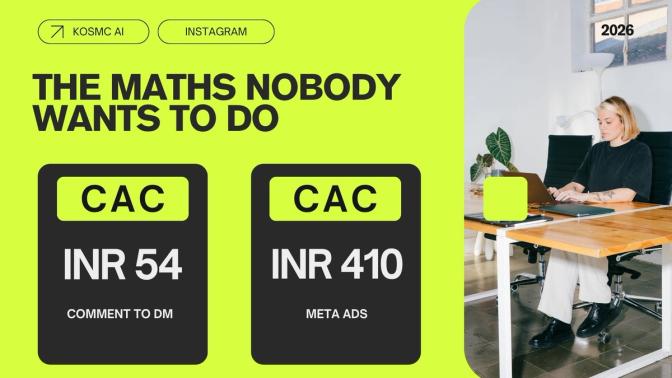
The comment-to-DM lead cost roughly 1/8th of the paid lead. And the close rate in DM was 3.2x higher than the landing-page conversion rate, because the user was qualified inside the conversation before the product link was ever sent.
This is not a one-off. Most brands running this properly see DM-sourced revenue hit 15–35% of total revenue within 90 days. The ones who get to 40%+ are the ones who stop treating it as a support channel and start treating it as a sales channel.
Why it's underpriced in 2026
Three reasons.
One: the old tools sucked, and brands got burned. ManyChat and the first wave of chat tools were built for Messenger, then duct-taped to Instagram. Flows broke. Meta API changes killed accounts. Founders tried it in 2022, had a bad experience, and mentally filed it under "doesn't work."
Two: it's not a dashboard metric. Performance marketers live inside ROAS. Comment-to-DM revenue doesn't show up cleanly in Meta Ads Manager. It shows up in Shopify with a UTM of "organic" or nothing at all. If you can't attribute it, you don't budget for it. If you don't budget for it, nobody owns it.
Three: it feels too manual to respect. Agencies don't pitch it because there's no retainer in it. Founders don't run it because they're busy. The people who do run it — usually a 23-year-old social manager with no title — are sitting on the highest-ROI channel in the building and nobody's asking them about it.
Underpriced channels always look like this. Boring to the people with budgets. Obvious to the people closest to the customer.
The 3-reply rule
Here's the thing that decides whether your loop converts or dies.
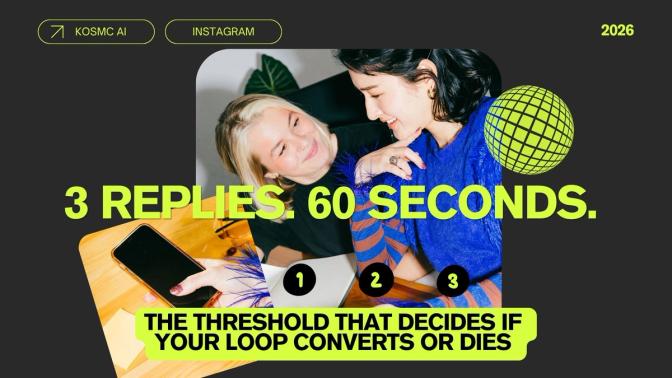
The user has to get three replies from your brand inside the first 60 seconds of commenting. Not three messages in a drip. Three replies in under a minute.
- Reply 1: The trigger DM (auto-sent when they comment the keyword).
- Reply 2: A qualifying question (auto-sent 15–30 seconds later).
- Reply 3: A response to their answer (this is where most brands fail — it has to feel human, even if it's a branching automation).
Why three? Because that's the threshold where Instagram's inbox surfaces your brand as an active conversation, not a notification. The user stops treating it like spam and starts treating it like a chat. The moment that flip happens, conversion rates jump 4–5x.
Most brands set up one auto-reply and call it a day. That's why their loop is dead.
The 4-stage DM script (steal this)
Every high-converting comment-to-DM flow I've seen follows the same four stages. The copy changes. The structure doesn't.
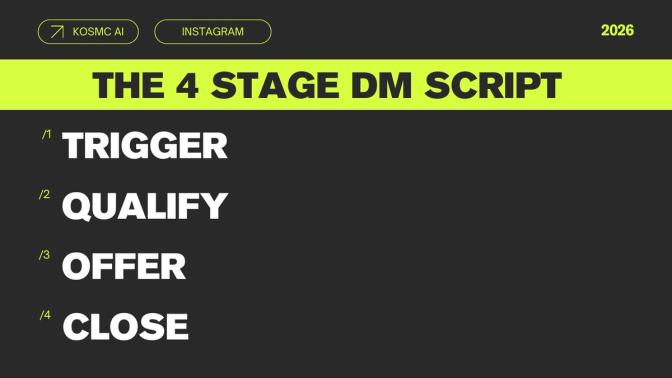
Stage 1 — Trigger (0 seconds) Acknowledge the comment. Deliver the thing they asked for. Never just dump a link.
"Hey! Saw you asked about the serum — here's the link: [link]. Quick q before you check out though: is this for you or a gift? Trying to send the right shade."
Stage 2 — Qualify (15–30 seconds) Ask a question only the buyer can answer. This does three things: it filters tire-kickers, gives you data, and keeps the conversation going so Instagram sees activity.
"Got it — for yourself. Last one: oily, dry, or combination skin? (changes which variant I'd recommend)"
Stage 3 — Offer (after they answer) Give the specific recommendation. Bundle if it makes sense. Drop a gentle scarcity or a first-time-buyer code.
"Perfect, combination skin = Serum 02. Most people pair it with the toner, here's the duo link with 15% off for first orders: [link]. Code auto-applies."
Stage 4 — Close (if no purchase in 30 min) One follow-up. One. Not a drip. Not three. One.
"Btw if you have any questions before ordering, just reply here — I'll personally answer."
That "personally" word does a lot of heavy lifting even when it's a flow. It reframes the whole interaction.
Every brand running this properly is converting 8–18% of triggered DMs into purchases within 24 hours. The ones converting below 5% have a broken Stage 2 — they're selling before qualifying.
The screenshot-able version
If you're reading this and want the tl;dr to save for later:
Comment-to-DM isn't a chatbot. It's a funnel disguised as a customer service channel. The brand that respects that difference owns 2026's cheapest acquisition channel.
Also:
Instagram automation for sales doesn't fail because of the automation. It fails because brands skip the qualify step and sell in the first message.
Screenshot whichever one lands for you.
What we built at Kosmc, and why
I'm building Kosmc AI, and Chat Automation is one of our core products. I'm not going to pretend this blog isn't informed by what I see every day inside brand accounts.
Most Chat Automation tools on the market are built for the flow-builder: drag-and-drop boxes, "if this then that", a dashboard that looks impressive in a demo. The brand sets it up once, it breaks in three weeks, and nobody touches it again.
We built Kosmc's Chat Automation around a different assumption: the loop is only valuable if the brand is running it daily, and that means the tool has to make the conversation itself feel native — not the flow-builder, the outcome. Keyword triggers on Reels, carousels, and Lives. Branching that doesn't break when Meta's API changes. A human-handoff that actually works when the flow can't carry the conversation. And — this is the part most tools miss — revenue attribution back to the specific Reel, specific keyword, specific DM thread that closed the sale. So when your performance marketer asks "where did this revenue come from", you have a real answer.
If you're already running this with another tool and it's working, keep running it. If you're one of the brands sitting on a 180K-follower account with 500 comments a day going unanswered — that's the leak. Plug it.
What changes if you run this for 90 days
- 15–35% of your revenue shifts from paid to owned channels.
- Your Meta ads get cheaper (higher organic engagement → better ad placements → lower CPMs).
- You build a conversation history with every buyer, which becomes the highest-quality dataset you own for retention, reactivation, and product launches.
- You stop being a brand that posts on Instagram and start being a brand that sells on Instagram. Different game.
The comment-to-DM loop isn't a hack. It's the mechanic Instagram has been trying to get brands to use for three years. Most of them still aren't. That's the opportunity.
In 12 months it'll be crowded. Right now it's not. That's what underpriced means.